Learn to Let It Go: Stop Carrying Emotional Baggage
9/5/2026
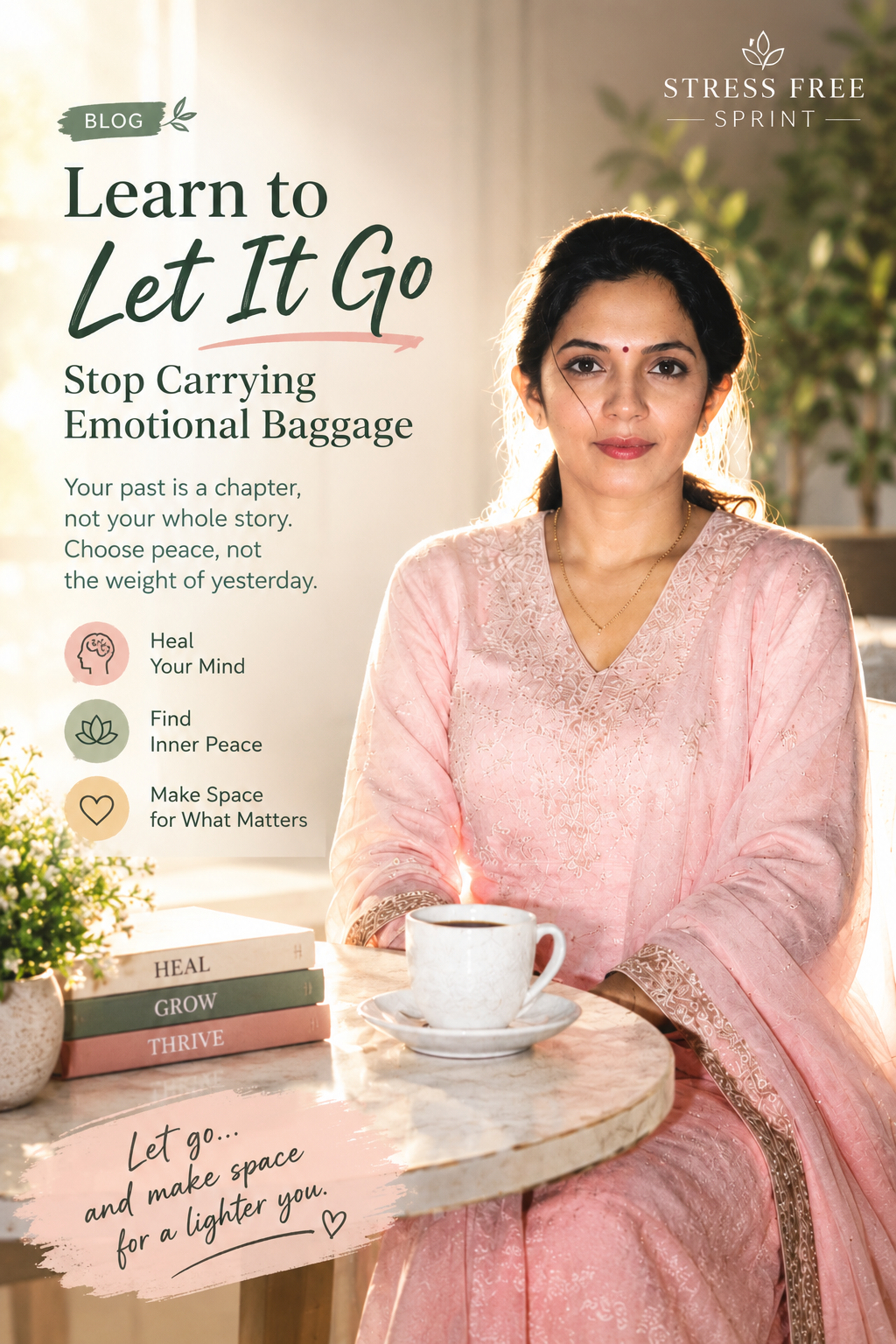
*Some things hurt us once. But sometimes, we keep carrying that hurt for years.*
A harsh word.
A broken relationship.
A betrayal.
An unfair situation.
Something someone did to you.
Something you wish had happened differently.
The event may be over.
But your mind keeps replaying it.
And every time you replay it, you experience a little bit of that pain again.
***You may have moved on physically… but emotionally, you may still be carrying the baggage.
We often think letting go means forgetting.
It doesn't.
***Letting go means deciding that the past no longer gets to control your present.**
---
***What is emotional baggage?
Emotional baggage is the collection of unresolved emotions, painful memories, disappointments, anger, guilt, resentment and fears that we continue carrying from past experiences.
Sometimes it sounds like:
*"Why did they treat me like that?"*
*"I should have said something."*
*"How could they do this to me?"*
*"What if things had been different?"*
*"I will never forgive them."*
These thoughts can quietly consume your mental energy.
You may be cooking, working, talking to someone or even smiling…
…but somewhere inside, your mind is still fighting an old battle.
---
** The cost of carrying what has already happened
Imagine carrying a heavy bag everywhere you go.
You carry it while working.
You carry it while sleeping.
You carry it into your relationships.
You carry it into new situations.
Eventually, you become so used to the weight that you forget what it feels like to be without it.
**Emotional baggage works the same way.**
Holding onto anger doesn't punish the person who hurt you.
Holding onto resentment doesn't change what happened.
Constantly replaying the past doesn't rewrite the past.
It only takes energy away from the present.
---
# Letting go doesn't mean saying, "It was okay."
This is one of the biggest misunderstandings about letting go.
You can say:
**"What happened was wrong, and it hurt me."**
And still choose:
**"I don't want to carry this pain every day anymore."**
You don't have to approve of what happened.
You don't have to forget.
You don't even have to reconnect with the person.
Sometimes letting go simply means creating emotional distance from what happened.
---
# So, how do you actually let go?
** 1. Accept that it happened
Stop fighting the reality of the past.
You cannot change what happened.
You can only decide what you want to do with it now.
Try telling yourself:
**"I cannot change the past. But I can choose how much space it gets in my present."**
---
** 2. Allow yourself to feel
Sometimes we try to "move on" too quickly.
We say:
*"I'm fine."*
*"It's nothing."*
*"I don't care anymore."*
But suppressed emotions don't simply disappear.
Give yourself permission to acknowledge what you feel.
**"Yes, that hurt me."**
**"Yes, I am angry."**
**"Yes, I felt rejected."**
Naming an emotion can be the beginning of processing it.
---
** 3. Separate the lesson from the pain
Every difficult experience doesn't need to become a lifelong burden.
Ask yourself:
**"What can I learn from this without continuing to suffer because of it?"**
Maybe you learned to set boundaries.
Maybe you learned what you don't want in a relationship.
Maybe you learned to value yourself.
Maybe you became stronger.
Take the **lesson**.
You don't have to keep carrying the **pain** to remember it.
---
** 4. Stop having the same argument in your head
Sometimes the person isn't even present anymore…
…but we're still arguing with them mentally.
We imagine what we should have said.
What they should have said.
What we wish had happened.
When you notice this, gently tell yourself:
**"That conversation is over. I don't need to continue it in my head."**
Bring your attention back to what is happening **right now**.
---
** 5. Release the need for closure from others
Sometimes we wait for an apology.
For an explanation.
For someone to finally understand our pain.
But what if they never give us the closure we want?
Does that mean we remain stuck forever?
**No.**
Sometimes closure is something you give yourself.
You can decide:
**"I may never get the apology I deserved. But I refuse to let that keep controlling my life."**
---
# A simple "LET IT GO" exercise
Take a piece of paper and write:
**1. What am I still carrying?**
Write honestly.
**2. Why does it still hurt me?**
Identify the emotion underneath it.
**3. What is outside my control?**
Write down everything you cannot change.
**4. What can I control today?**
Your boundaries.
Your response.
Your attention.
Your choices.
Your healing.
Then finish with this statement:
> **"I acknowledge what happened. I honour what I felt. I take the lesson. And I choose not to carry the pain into every new day."**
Take a deep breath.
And let the page hold what your mind has been carrying.
---
# You don't have to carry yesterday into tomorrow.
Your past is a chapter of your life.
**It is not your entire story.**
You deserve to experience today's moments without constantly paying the emotional price for yesterday's experiences.
Some things cannot be changed.
Some people cannot be changed.
Some situations will never get the perfect ending you imagined.
But you can still choose peace.
**Letting go is not weakness.**
It is not pretending that nothing happened.
It is choosing yourself after everything that happened.
**Don't carry what you were never meant to carry forever.
**Learn to let it go.**
**Make space for peace.**
**Make space for yourself.**
---
### Stress Free Sprint
At **Stress Free Sprint**, we believe stress management isn't about eliminating every difficult experience from life.
It's about learning how to respond to life's challenges without allowing them to consume you.
**Your past deserves understanding.
Your present deserves your attention.
And your future deserves your energy.**
**Don't carry the baggage. Learn to let it go.**
Pause
Breath
@intellectualpropertyrightsreserved
#StressFreeSprint